5 Biggest Problems I See with Founders Trying to Be Data-Driven
In today’s world, making data- driven decisions is seen as the new norm. As much as I love the norm, I hate how most Founders get this wrong.
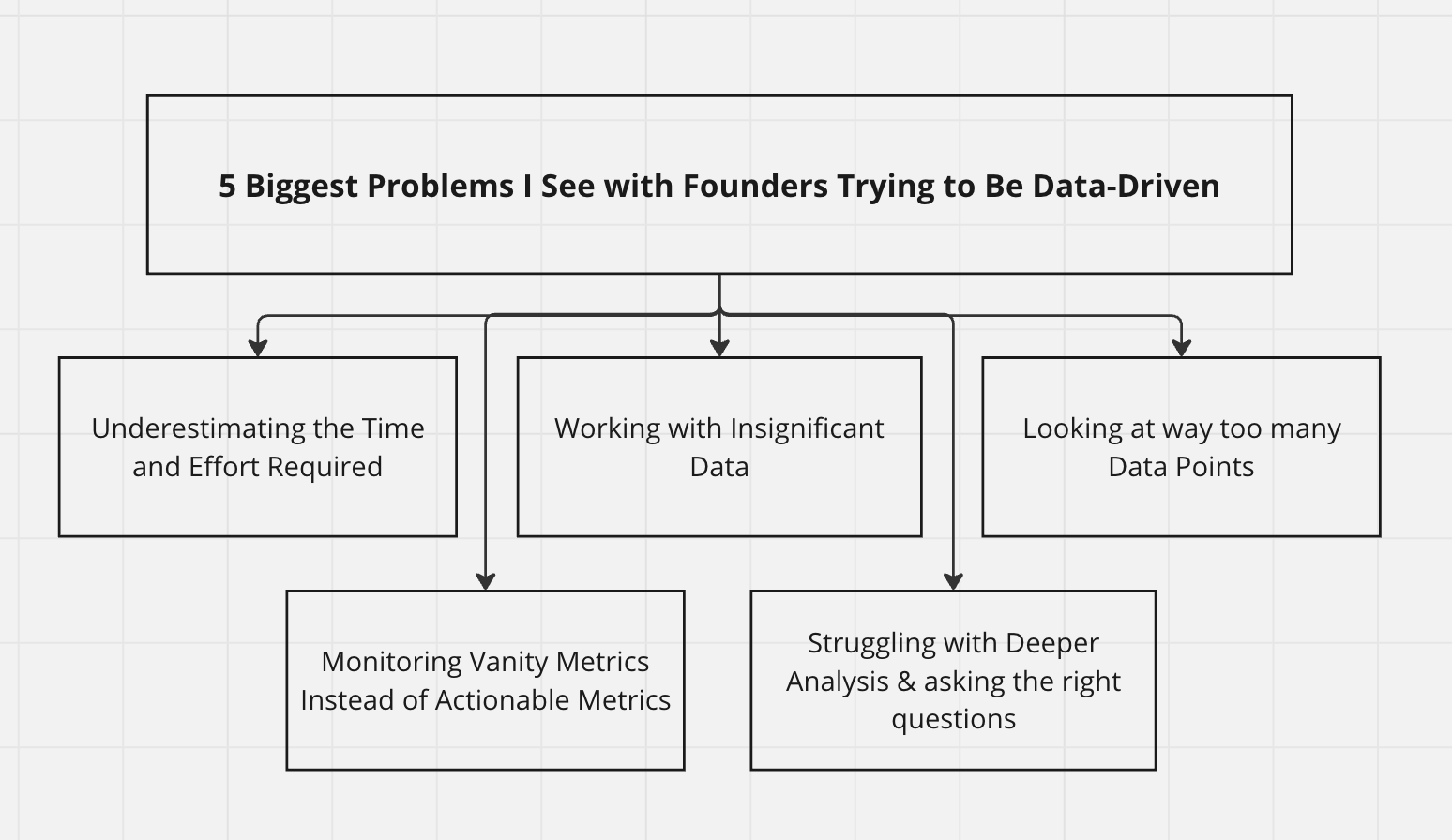
In today’s world, making data-driven decisions is the new norm. As much as I love the norm, I hate how most Founders get this wrong.
To me, being data-driven has four key stages:
- Getting data at your disposal
- Clearly defining the problem statement, & listing down the hypothesis/ metrics to look at
- Transforming data to churn actionable insights out easily
- Combining actionable insights + your intuition to make the final decision
In theory, it sounds pretty straightforward - but trust me, it’s not.
Through this article, I want to help you understand the common pitfalls you’re likely to encounter or have already encountered while trying to be data-driven.
Let’s get into it.
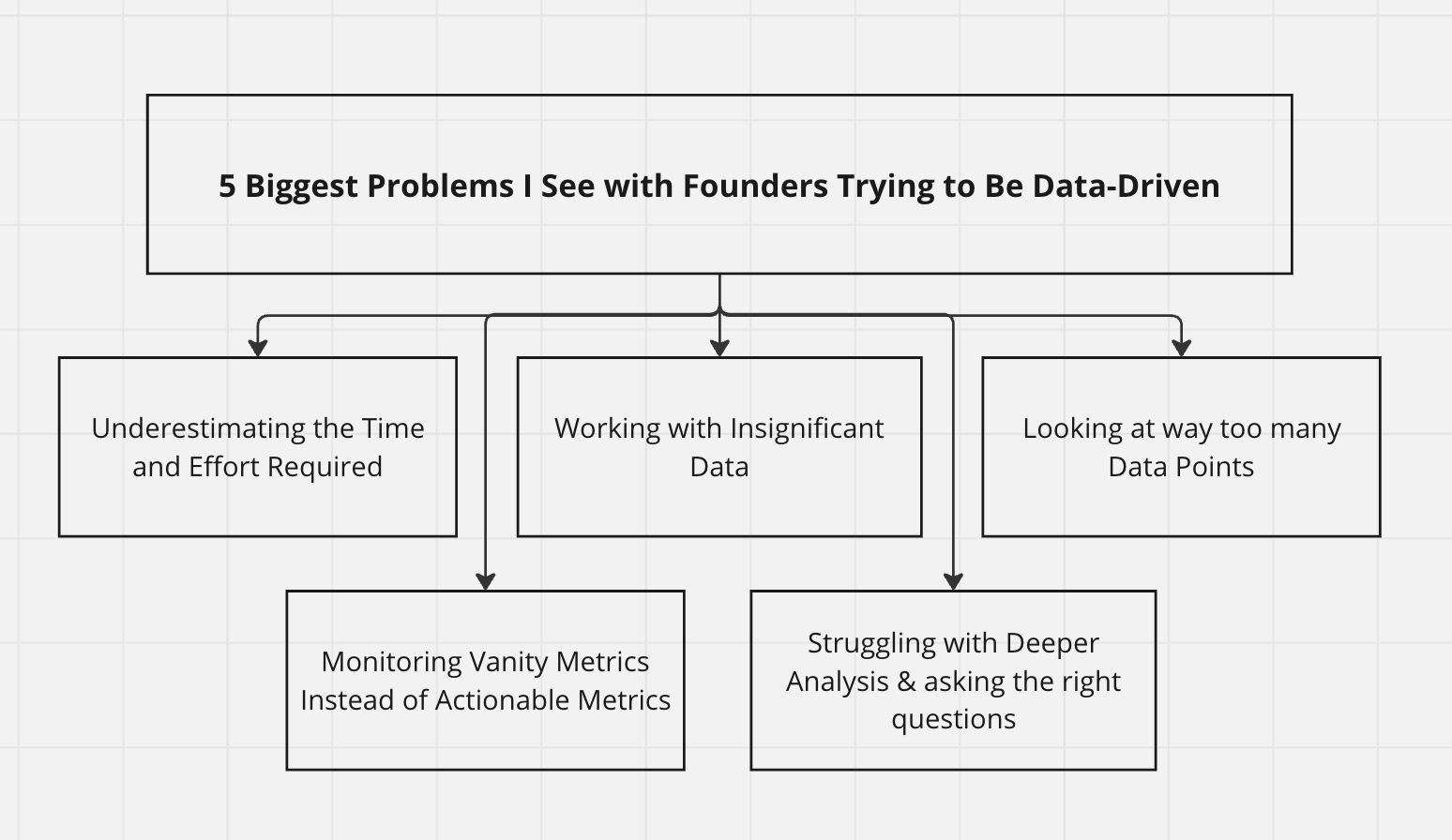
Underestimating the Time and Effort Required
8 out of 10 Founders I speak with, believe that getting data to speak is easy, & does not require much time and effort. Hence, they’re also not willing to spend on analytics.
They assume that they can get clear actionable insights without really working on collecting the right data, cleaning it, listing the hypothesis, analyzing & finally interpreting it.
Eventually, this misconception leads to frustration when quick, actionable insights are not immediately available.
You need to realize that churning the right insights out of data is time-consuming. Not spending enough time on it will either lead you to have the wrong insight or no insight at all.
Jumping the Gun with Insignificant Data
Quite a few Founders try to be data-driven too early in their product journey, with insignificant data.
With limited/ insufficient data, you’re likely going to be making decisions based on misleading or inconclusive information.
When you don’t have enough data, it’s always better to rely on other techniques to make decisions - like your own intuition, talking to your users, or observing user interaction with the product (recordings).
These techniques are going to give you a much better result compared to data.
There’s no hard and fast rule for when you should start relying on data because it could differ from business to business. But at minimum, you should wait until you’re analyzing numbers in the hundreds. Before that, use other techniques for decision-making.
Overloading on Data Points
Another tendency I’ve noticed among Founders is the desire to look at every possible data point, believing that this will help them make effective decisions.
But the reality is quite the opposite in the world of analytics.
More data points do not necessarily correlate to better insights. Additionally, looking at so many metrics usually leads to information overload, making it difficult to build any sort of story around the product that can be used for insight generation.
This is also the stage where I’ve seen a lot of Founders give up on analytics.
Ideally, you should start with as few data points as possible to just get an overview of what’s happening in your product, and then expand slowly and steadily when you need to.
Don’t start with a list of 100 metrics right away. It’s going to take you nowhere.
Monitoring Vanity Metrics Instead of Actionable Metrics
One of the biggest pitfalls I’ve noticed is Founders getting stuck in monitoring vanity metrics - those that look impressive but don’t provide actionable insights.
These metrics are floating all around Google and ChatGPT - hence, it’s easy for people to fall into the trap & feel that they’re monitoring the right metrics.
But if you’re looking to be truly data-driven, you need to let go of fancy metrics and start looking at actionable ones. I’ve written a detailed guide on how to create your analytics strategy, that talks about vanity vs actionable metrics. I hope this helps you chart out good metrics for your product.
Struggling with Deeper Analysis
Asking the right questions, & being able to build a comprehensive flowchart of things to look at, to be able to get a definite answer is the core skill of a good analytical person.
Without being good at this, you’re going to end up with nothing out of data. You can collect all the data you want, but you must have this skill to extract valuable insights.
If you don’t, you’re going to be stuck with surface-level analysis that doesn't drive meaningful improvements or innovations.
There’s no shortcut to acquiring this skill. It comes with experience and practice.
If you understand the five pointers above and can navigate them when you’re working on analytics, I can guarantee you that you’ll get better results out of your data.
And if there’s something you’re struggling with, feel free to book a call with me. I’d love to have a chat and help you out.
Hope this was helpful. If you’re looking for any help with Mixpanel, feel free to reach out using any of the below methods.
LinkedIn | Email - anshdoesanalytics@gmail.com | Book a slot on my calendar

![[Week 28] Learning Mixpanel: Computed Properties](/content/images/size/w600/2026/02/e73fb366-1c52-4f79-a28f-4a0b60d6998c_836x723.png)
![[Week 27] Learning Mixpanel: Bucket Customisation Types](/content/images/size/w600/2026/02/a81f7bcb-4886-4711-b1b8-af8c5fc6b1b8_463x476.png)
![[Week 26] Learning Mixpanel: Mastering Attribution with Mixpanel](/content/images/size/w600/2026/02/4e3a164c-bfb1-479f-9f09-2f8890eac413_885x787.png)