70% of Your Branded Search Conversions Would Have Happened Anyway

The short version
You've scaled spend and you can finally see per-channel outcomes. Which channel drives trials, which trials convert to paid, which stick around. That's a real milestone, and most teams never get there.
Here's the problem waiting on the other side of it. Everything you built tells you where users came from. None of it tells you what actually caused the revenue. Those are different questions, and at small budgets the gap doesn't matter much. At real budget it's where a lot of money quietly dies, because "this channel is correlated with revenue" is not "this channel caused revenue," and a CFO asking you to defend a number can tell the difference.

What breaks once you can already see per-channel outcomes?
If your ad, product, and revenue data still isn't connected, that's the earlier post, and you should start there. I'm assuming you've done it. You've stitched identity across your marketing site and your app, you can follow a user from click to paid, and you can cohort by the channel that brought them.
But here's the thing about the attribution you built. It's correlational. It tells you that users who touched a campaign went on to pay. That is genuinely useful, and at small scale it's enough to act on. Spend more where the paying users came from, less where they didn't.
The trouble starts when the budget gets big and someone wants you to defend it. "Correlated with revenue" and "caused revenue" are not the same sentence, and the space between them is exactly where budget gets wasted.
Finding the gap between what your channels claim and what they actually caused is the first thing I check in an audit. If your CAC feels too good to be true, it probably is. Book a free call and let's find out.
Why does single-touch attribution break at scale?
At real budget, nobody converts off one touch.
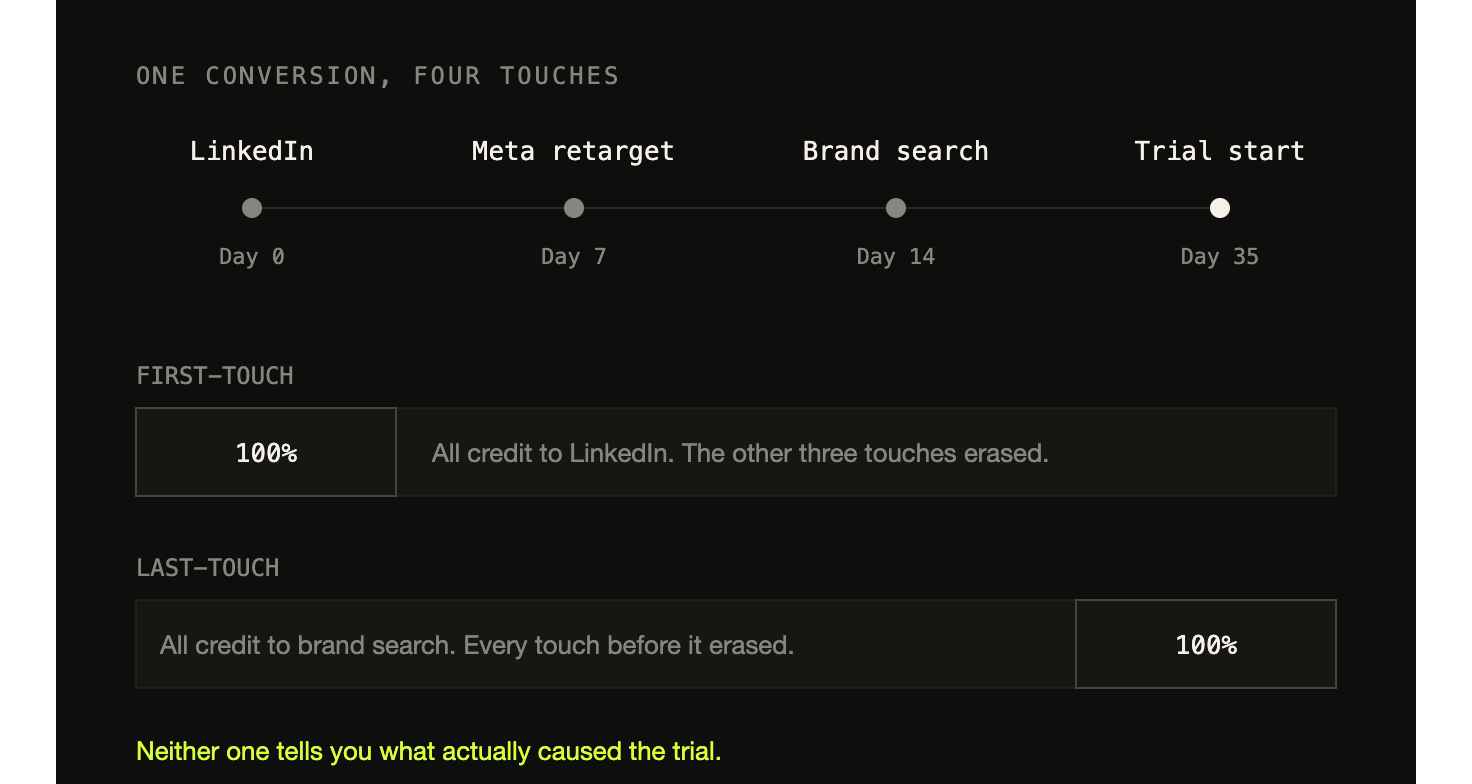
Here's a normal journey. Someone sees your ad on LinkedIn. A week later they get retargeted on Meta. Later they Google your name and click a brand-search ad. Three weeks after that they start a trial. Four touches, spread across three weeks, before a single dollar shows up.
Single-touch attribution throws almost all of that away. Last-touch hands every bit of credit to brand search. First-touch hands it all to LinkedIn. Both are wrong in the same way: they take a story with four characters and pretend one of them did everything.
Multi-touch is better. Linear, time-decay, position-based, or a data-driven model, they all spread the credit across the touches instead of dumping it on one. If you're choosing a model, that's the direction to go. But be honest about the ceiling. Multi-touch only redistributes credit among the touches you tagged. Everything untagged is invisible to it. And even with perfect tagging, it divides up the credit. It never asks whether there was anything to take credit for.
The question no attribution model can answer
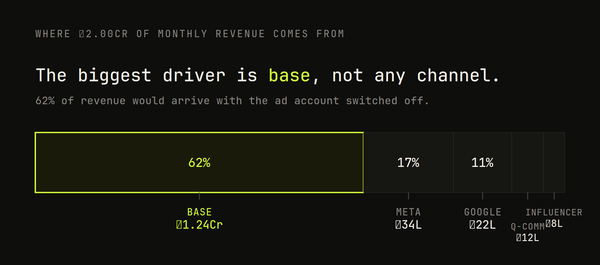
Your brand-search campaign looks incredible. Huge conversion numbers, cheap cost per conversion, green across the dashboard. But think about who those people are. They typed your company name into Google. They already knew who you were. Most of them were going to find you anyway. You're paying to put an ad in front of demand you already created, and then paying again when they convert.
Attribution can't see this. In its world every tagged touch looks like it contributed, so a click that changed nothing and a click that changed everything get counted the same way. The brand-search ad was there at the end, so it gets the credit, whether or not it did anything.
Retargeting your own existing users is the same problem wearing a different shirt. You're paying to re-reach people who were coming back regardless. The ad runs, they return, the platform books a conversion. Did the ad cause the return, or just happen before it? Attribution has no idea, and neither do you from looking at it.
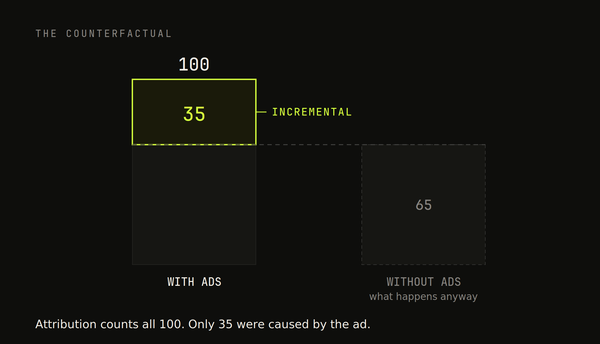
This is the ceiling on the entire category. No attribution model, however sophisticated, answers "would this have happened anyway." The question is structurally outside what attribution can measure, because attribution only ever sees the conversions that happened, never the ones that would have happened without the ad. For that you need a different tool.
Incrementality: the CFO-proof answer
Incrementality measures the thing attribution can't: the counterfactual. How many conversions would you have gotten without the ad? Subtract that from what you got with it, and the difference is what the channel actually caused. Everything else was going to happen anyway.
The simplest real version is a geo holdout. Turn a channel off in a set of matched regions, keep it running everywhere else, and read the gap in conversions between them. If the regions where you cut spend convert almost as well as the ones where you didn't, the channel wasn't causing much. If they fall off a cliff, it was. You don't need a data-science team for the basic version. You need matched regions, the discipline to actually turn something off, and the patience to wait a few weeks.
There's a full menu beyond that, ghost ads, PSA tests, on-off tests over time, and the platform-native lift tools that Meta, Google, and TikTok run for you, and each one has ways it can quietly lie to you if you set it up wrong.
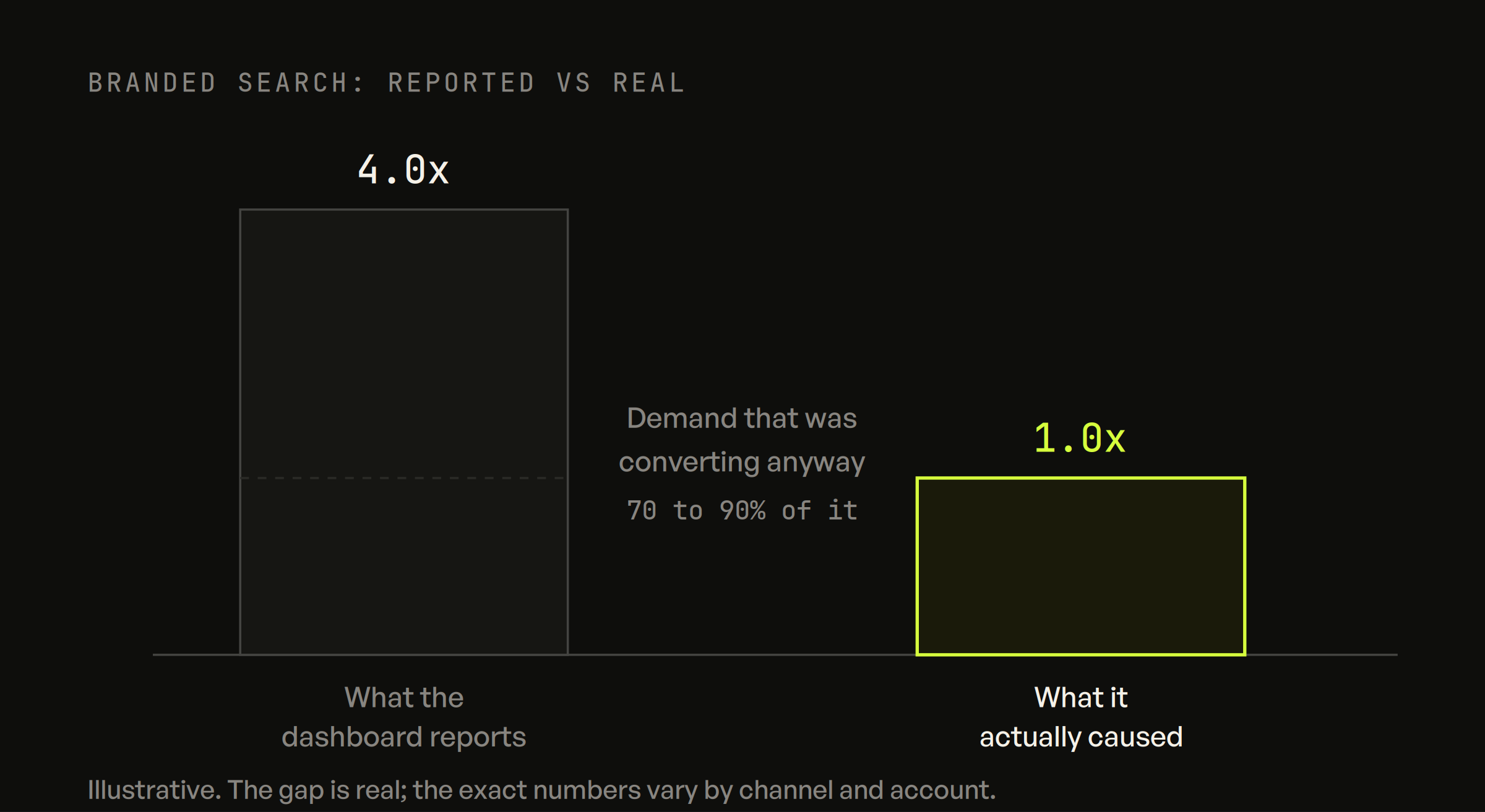
The reframe that matters is what this does to your reported numbers. Branded search is the cleanest example, because it's the channel most likely to be capturing demand you already made. When people actually test it, somewhere between 70 to 90% of branded search conversions turn out to be non-incremental, meaning they'd have happened without the ad. So a brand-search campaign reporting a 4x return can be sitting far below that once you strip out the sales that were coming regardless.
A geo holdout is simple in theory and easy to botch in practice, wrong regions, wrong window, wrong read. I set these up for growth teams so the first test you run is one you can trust. Book a call.
MMM: splitting the whole budget, including what you can't tag
Incrementality answers one channel at a time. Useful for validating your big bets, slow if you want to split an entire budget across a dozen channels.
That's what MMM is for. Media mix modeling looks at your whole spend across every channel and models how it maps to revenue, then tells you how to divide the budget. Not one channel in isolation, the whole portfolio at once.
Its real superpower is the channels attribution is completely blind to. Anything you can't put a UTM on. Offline, some social, brand, podcast, connected TV. MMM doesn't care, because it works on aggregate spend and outcomes, not individual tagged journeys. It was built decades ago for exactly the world where tracking wasn't possible, which is why it holds up now that tracking is leaking everywhere.
Now the honest part, because most teams reach for MMM way too early. It needs enough spend, enough variation in that spend, and enough history for the model to find real patterns instead of noise. As a rough marker, the practitioner consensus puts the point where MMM starts earning its keep at around 3 to 5 million dollars a year in media spend and roughly 20 million in revenue, with 18 to 24 months of clean weekly data across several channels. Below that, the model is guessing with confidence, which is worse than not having it.
And even when you're big enough, don't run it on its own. An MMM trained on correlational data learns correlational answers. You calibrate it with incrementality experiments, so the model has causal ground truth to anchor to instead of just historical patterns. The model for breadth, the experiments for truth.
Fix the accuracy issues underneath all of this
None of the above is worth anything if the raw numbers are dirty. You can layer the most sophisticated incrementality program in the world on top of broken inputs and all you get is a confident wrong answer. Three accuracy problems make CAC and channel ROI untrustworthy at scale.
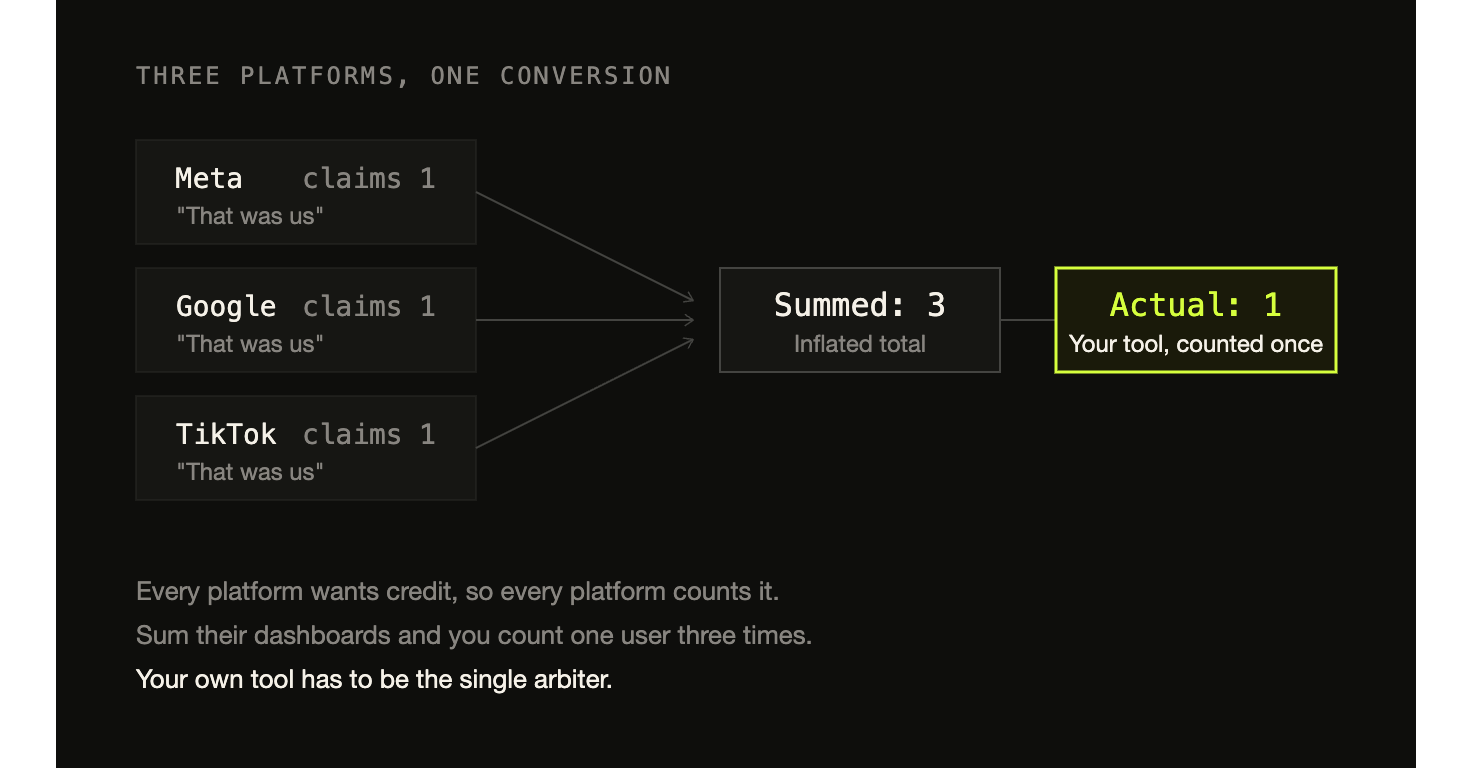
Dedup across platforms. Meta, Google, and TikTok will each claim the same conversion. Add up what the three platforms report and you'll often have more conversions than you actually had, sometimes counting a single user two or three times. Your own tool has to be the single arbiter. One conversion, counted once, no matter how many platforms raise their hand for it.
Consistent revenue definitions. "Conversion" has to mean the same thing everywhere. Trial start, paid signup, and retained-after-30-days are wildly different numbers, and if they drift across dashboards, some counting trials and some counting paid, your CAC is fiction. Pick the definition, write it down, enforce it in every place a number gets computed.
One source of truth for spend and revenue. Pull the actuals into one place, your warehouse or your product tool, and compute CAC there, once. Not reconciled three different ways at the end of every month from three exports that never quite agree.
Get this wrong and every model you build on top inherits the error, quietly, and you won't notice until a number you staked a decision on turns out to have been wrong for months.
This measurement layer is exactly what I build for growth teams. Deduped conversions, one honest definition of revenue, CAC computed once from data you can trust. If your numbers are reconciled three different ways every month, that's the thing to fix first. Book a call.
The hierarchy: use the right tool for the question
Three tools, three questions, three altitudes.
Attribution tells you where users came from. It's for day-to-day channel management and directional calls. Which campaigns to pause, which creative is pulling, where to look next. Fast, cheap, good enough for the everyday decisions. Just don't ask it what caused revenue.
Incrementality tells you what actually caused revenue. It's for validating your biggest bets before you pour more money in. Slower, one channel at a time, but it's the only thing that answers the counterfactual. Run it on the channels where the stakes are high enough to justify turning spend off for a few weeks.
MMM tells you how to split a large budget across everything, including the channels you can't tag. It's for top-down allocation once you're big enough to have the spend, the variation, and the history to feed it. Calibrated with incrementality so it's grounded in causation, not just correlation.
The discipline is matching the method to the budget and the question. Don't run MMM at Seed, you don't have the data and it'll just make up an answer. Don't defend an eight-figure budget on last-touch, because the moment someone competent asks how you know, you won't have a real answer.
At real budget, "the dashboard says it converted" is not something you can defend, and the fix isn't a better dashboard. It's knowing which of these three questions you're actually asking, and reaching for the one tool that can answer it.
Frequently asked questions
Why would branded search conversions have happened anyway?
Because of who those clicks are. Someone searching your brand name already knows you and was already coming. The click is a toll booth on a road they were driving down regardless. Attribution can't see this — in its world every tagged touch looks like it contributed, so a click that changed nothing and a click that changed everything score identically.
Is retargeting the same problem?
Yes, wearing a different shirt. You're paying to re-reach people who were coming back regardless, and the dashboard rewards you for it.
What's the difference between attribution and incrementality?
Attribution is correlational — it tells you users who touched a campaign went on to pay. Incrementality measures the counterfactual: how many conversions you'd have gotten without the ad. Subtract that, and what's left is what your spend actually caused.
What is a geo holdout?
The simplest real incrementality test. Turn a channel off in a set of matched regions, keep it running everywhere else, and read the gap in conversions. Simple in theory, easy to botch — wrong regions, wrong window, and you measure noise.
When should you use MMM instead of incrementality testing?
Incrementality answers one channel at a time, which is useful for validating big bets and slow for splitting a whole budget. MMM models your entire spend against revenue at once. Its real advantage is the channels attribution is blind to — anything you can't put a UTM on: offline, brand, podcast, connected TV.
What has to be true before any of this works?
Your raw numbers have to be clean. Dedup across platforms — Meta, Google and TikTok will each claim the same conversion, so the three together often report more conversions than you had. And "conversion" has to mean the same thing everywhere; trial start, paid signup and retained-at-30-days are wildly different numbers.
Want this on your own stack?
Datalyze rebuilds your data foundation, then finds the growth it's been hiding — proven across 150+ startups.
Book a free analytics audit →