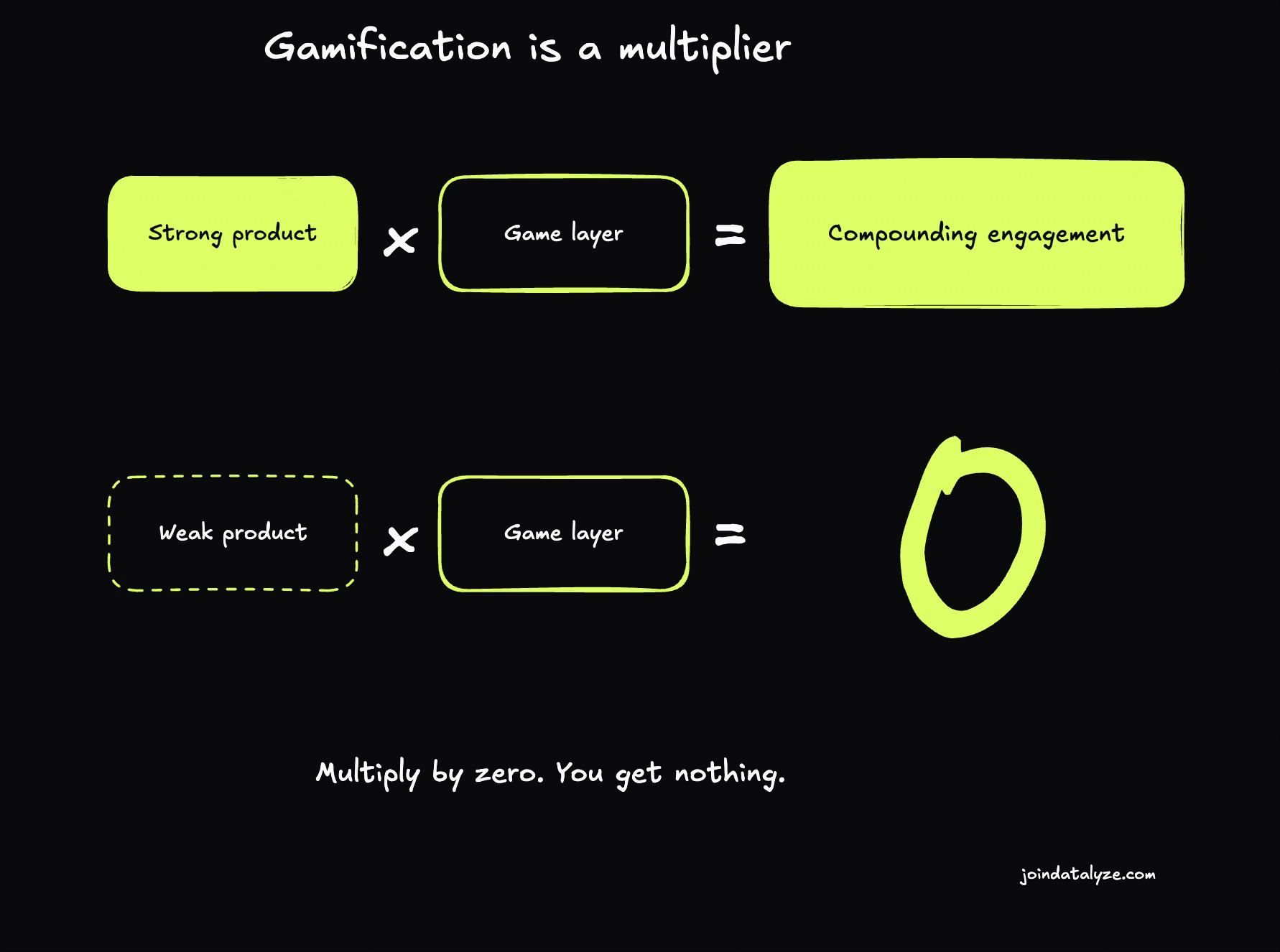
Gamification is a multiplier. But multiply by zero, and you get nothing.
Duolingo has 19 million daily active users.
Foursquare, once held up as the gold standard of gamified apps with 50 million users at peak, quietly retired its own badges and points system before splitting into two separate apps.
Both used streaks, badges, leaderboards but only one survived its own mechanics.
What does the research on gamification actually say?
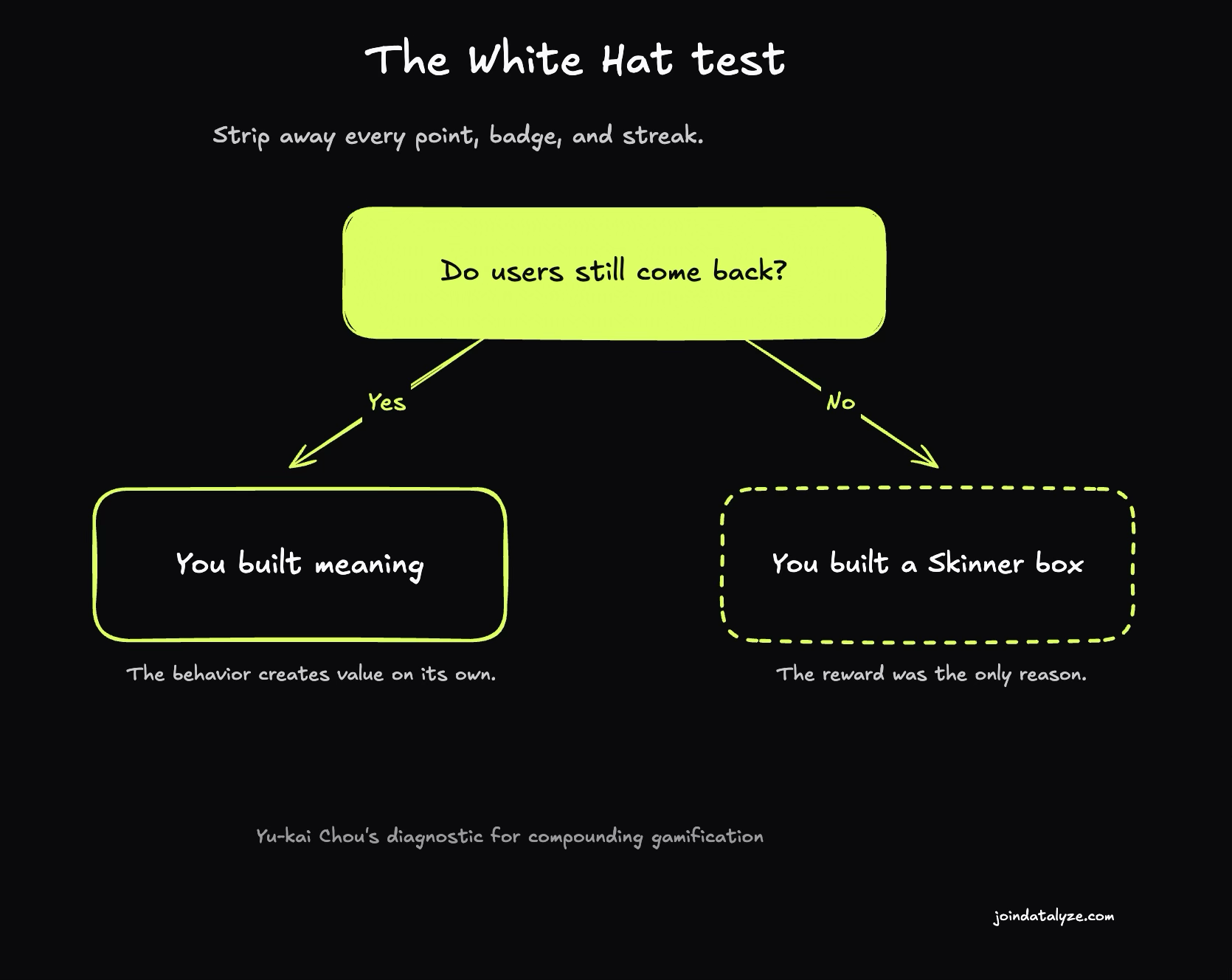
Yu-kai Chou, whose Octalysis gamification framework has been adopted by LEGO, Microsoft, and Porsche, offers a blunt diagnostic he calls the White Hat test: if users keep doing the behavior when the points stop, you built meaning. If they stop the instant the rewards disappear, you built a Skinner box.
Decades of research on self-determination theory backs this up. Tangible extrinsic rewards, applied in isolation, do not sustain motivation. Basically, the reward systems featured in many gamified products may in fact harm long-term engagement, not enhance it.
Three patterns separate the products that compound from the ones that collapse.
First, the rewarded action must be the value-creating action. Duolingo rewards finishing a lesson which is exactly the behavior that produces the outcome users wanted: learning a language. Snapchat rewards messaging a friend daily which is exactly the behavior a friendship requires. The streak measures what the user already wanted to do.
Second, mechanics must hold up across different retention windows. Day-one retention and month-six retention are different problems. Duolingo solves both. Most gamified products solve neither past the initial novelty spike.
Why did gamification work for Duolingo?
Duolingo ran over 600 experiments on streaks alone over four years.
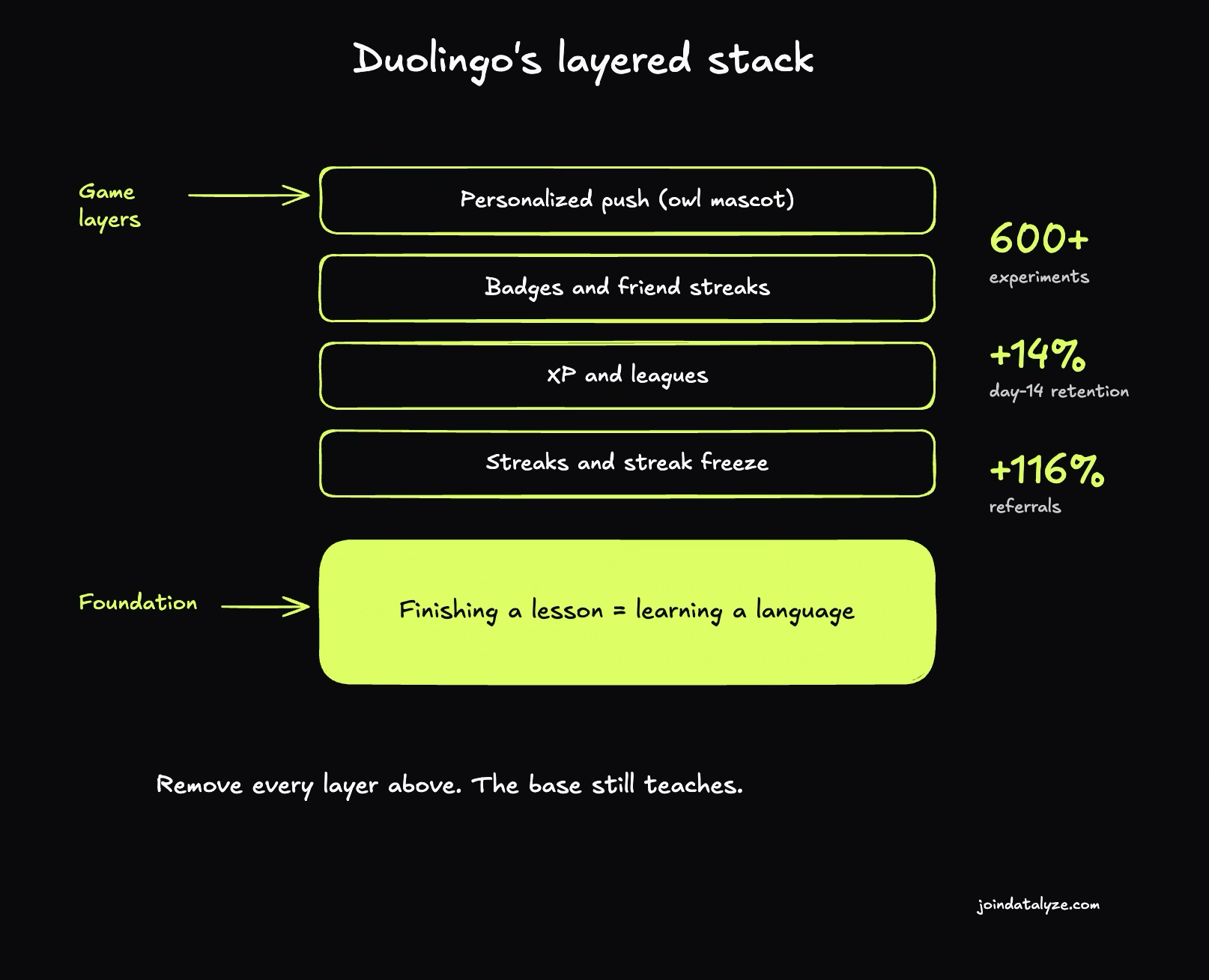
The result: a streak freeze so users don't lose progress over a missed day, a personalised push notification system tied to its owl mascot that drove a 5% lift in daily active users, and a layered system of XP, leagues, badges, and friend streaks calibrated to activate different motivations at different stages of a user's journey.
After an overhaul in early 2022, the share of power users rose from 20% to over 30%. Churn fell from 47% in 2020 to 37%. Streak wagers alone boosted day-14 retention by 14%. A badge reward system produced a 116% jump in referrals.
But remove every mechanic, and Duolingo is still a language learning app. The atomic behavior finishing a lesson delivers value with or without the streak. The game makes users do it more often but it does not invent the reason to do it.
However, I’d like to point out one very honest caveat. Duolingo's default lesson difficulty is calibrated low. Users who enable hard mode learn faster and retain more. So, even successful gamification optimises for engagement in ways that can trade off against the core outcome. While building your product, you’d need to balance similar kinds of tension.
Why did gamification fail for Foursquare?
Foursquare launched in 2009 with points for check-ins, badges for venue categories, and Mayor status for the user who checked in most frequently at a given location. It grew to 50 million users.
It was a textbook case.Then the textbook was wrong.
As social networks built location features, Foursquare's core loop began to decay.
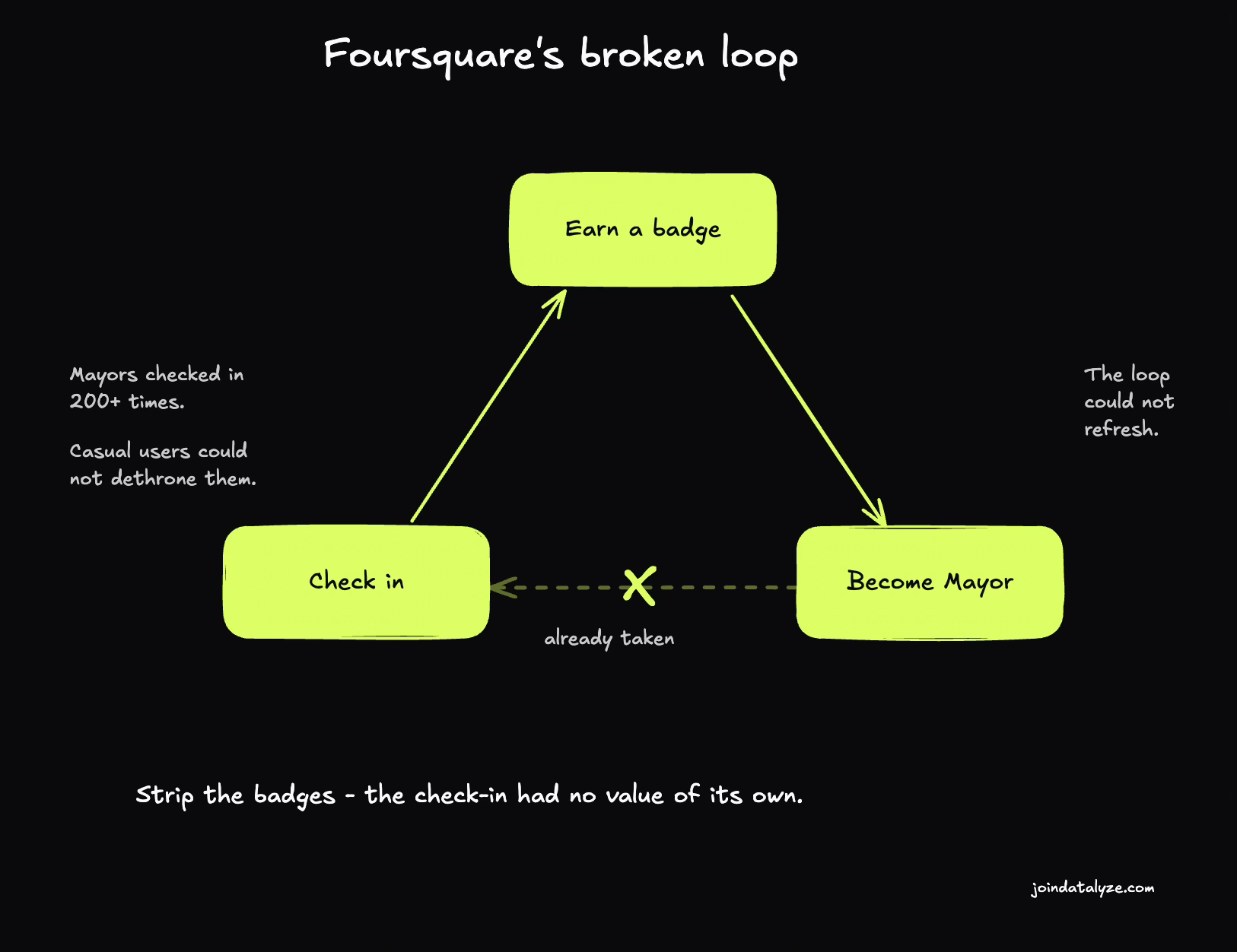
Mayors became entrenched because asual users could not realistically dethrone someone who had checked in 200 times at their neighbourhood café. The challenge flattened. The loop stalled.
The deeper problem, as Chou's framework identifies, is that Foursquare's design leaned almost entirely on extrinsic drivers: points, badges, competitive status. There was no meaningful intrinsic layer - no tools for genuine connection, discovery, or collaboration that would have held users once the novelty of Mayor status wore off.
The atomic behavior Foursquare rewarded was checking into a venue. That action, on its own, delivered nothing. Remove the badge and there was no reason to be there.
The company eventually acknowledged this by splitting into two products. Swarm kept the social check-ins. The new Foursquare became a local discovery app, closer to Yelp than to its original self. The real value had always been in tips and recommendations. Foursquare had treated that as a side effect of the game rather than the point of it.
Conclusion
Strip both down to their atomic behavior and the pattern is clear.
When the rewarded action delivers value independent of the reward, gamification compounds.
When the rewarded action only exists to chase the reward, gamification is a sugar high with a predictable crash.
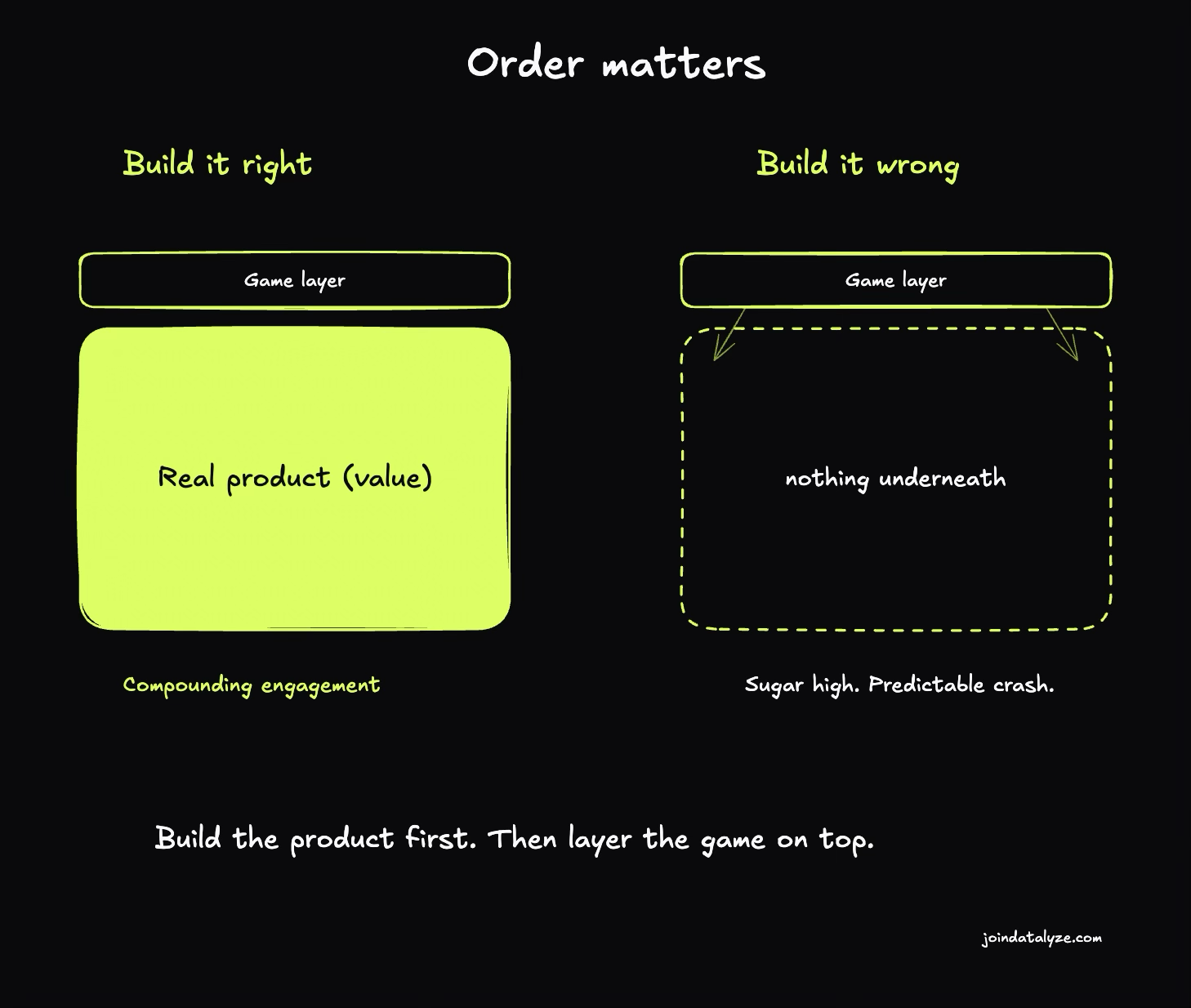
Founders who reach for gamification first usually do so because the product underneath is weak and they hope mechanics will paper over it. They won't. The mechanics will only accelerate the discovery that there is nothing there.
Build the product first. Then layer the game on top.
Frequently asked questions
Does gamification actually work?
It's a multiplier, not a substitute. It amplifies a product people already get value from, and multiplying zero by anything still gives you zero. If the underlying loop doesn't work, streaks and badges won't fix it.
Why did it work for Duolingo?
Because the core product already delivered something people wanted — language learning — and the streak amplified a habit that had somewhere to go. The mechanic was attached to real value.
Why did it fail for Foursquare?
Because badges and mayorships were the value, rather than an amplifier of it. Once the novelty wore off there was no underlying reason to keep checking in.
When should you add gamification?
After the fundamentals work — when people already come back for the product itself and you want more of them to. Before that, gamification is a distraction from the thing that's actually broken.
Get new posts by email
Simplifying analytics for Founders and PMs. One email when a post goes out.