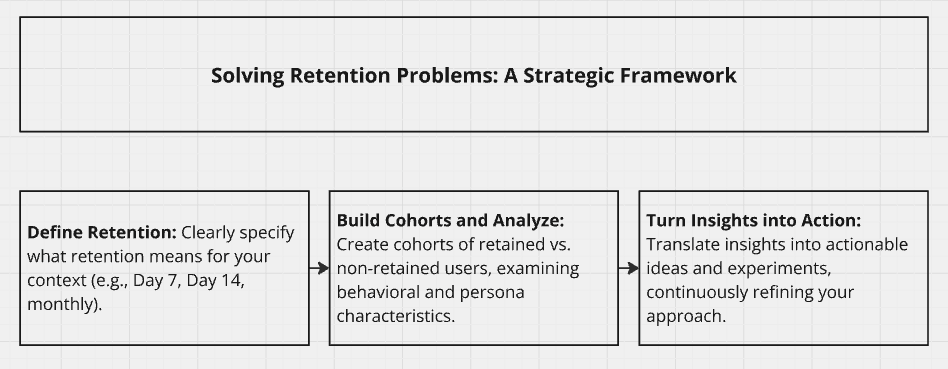
Solving Retention Problems: A Strategic Framework
A three-step framework for retention: define what retention means for you, compare retained and churned cohorts, then turn the gaps into experiments.
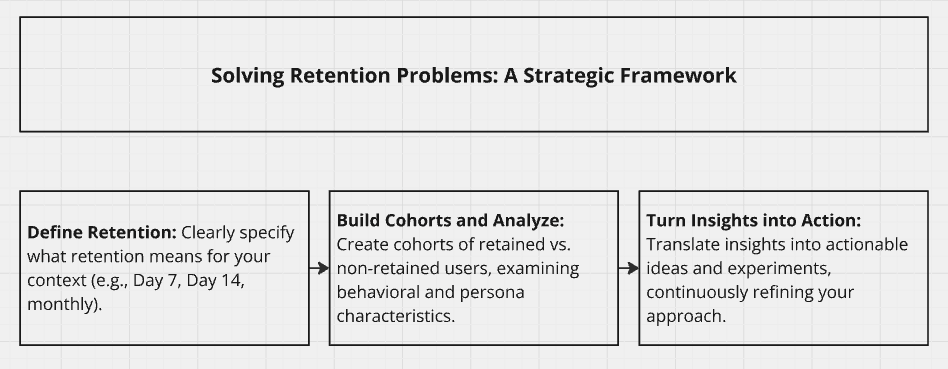
The short version: Three steps. Define what retention means for you first — which day, and bounded or unbounded. Then build cohorts of retained versus non-retained users and compare their characteristics. Then turn the differences into experiments and watch the metric move.
Retention is one of the most challenging aspects to tackle in any business. It’s complex, multifaceted, and requires a deep understanding of user behavior.
However, by taking a step back and leveraging data effectively, you can uncover patterns and differences between retained and non-retained users.
From my experience of having worked with multiple businesses on improving their retention, I’ve been able to come up with a three-step framework to help you systematically solve retention issues.
Let’s get into it.
How do you define retention for your product?
The first step in solving retention problems is to clearly define what retention means for your specific context.
Are you focusing on Day 7 retention, Day 14, or monthly retention?
You also need to determine whether you are looking at bounded or unbounded retention.
Without a clear definition, your analysis will get messy and lead to inconclusive results.
Note: Please ensure that you have enough users in both the retained and not retained cohorts while defining retention. Without significant data in these groups, your analysis will not be meaningful.
How do you build and compare retention cohorts?
Once you have a clear definition of retention, the next step is to create cohorts of retained vs non-retained users.
This is where the real analysis begins. Start by examining the basic characteristics of each cohort and gradually dive deeper into the data.
Key characteristics:
- Behavioral: How users interact with your product – engaging or performing actions within the product.
- User Persona: Demographics, channel of acquisition, job title, etc.
Study both these factors together to find meaningful insights. You’re rarely going to find good insights by studying them individually.
From a data standpoint, you have to understand 2 things:
- At what stage are the non-retained users dropping off from the product, and what was the reason? Did they face a bug? Did they not find what they were looking for?
- What is the distribution difference across factors (behavioral, user persona) for retained vs. non-retained users? For example, you might see that 80% of retained users were acquired via Google, but only 10% of non-retained users were acquired via Google. Or, 90% of retained users perform action X within 3 days of signing up, compared to only 5% of non-retained users doing so.
Note: Don’t jump straight into data. Create a hypothesis tree chart to list all potential factors that you feel could influence retention.
List out all possible hypotheses and explore each one thoroughly. Keep asking “why” and going deeper.
The deeper you go into your data, the better and more actionable insights you’ll find.
How do you turn retention insights into action?
With insights in hand, the final step is to translate them into actionable ideas and experiments. This might involve tweaking product features, enhancing user onboarding, or personalizing user experiences based on the identified patterns.
Talk to the product team → develop experiments to test hypotheses → monitor impact on retention metrics → iterate based on results and continuously refine your approach.
Conclusion
Solving retention problems is an iterative process. It requires continuous effort and refinement. Don’t be disheartened if initial strategies don’t yield immediate results.
By systematically defining retention, analyzing cohorts, and translating insights into action, you can develop a robust strategy to enhance user retention.
Remember, retention is not just about keeping users but understanding and fulfilling their needs consistently.
Hope this was helpful. If you’re looking for any help with Mixpanel or analytics, feel free to reach out using any of the below methods.
LinkedIn | Email - anshdoesanalytics@gmail.com | Book a slot on my calendar
Frequently asked questions
Why is retention so hard to fix?
It's complex, multifaceted, and it depends on genuinely understanding user behaviour rather than one metric. The way through is to step back and let the data show you the patterns separating retained from non-retained users.
What does defining retention actually involve?
Picking the window — Day 7, Day 14, monthly — and deciding whether you're measuring bounded or unbounded retention. Skip this and every downstream number means something slightly different to each person reading it.
What's the difference between bounded and unbounded retention?
Bounded asks whether a user came back in a specific window; unbounded asks whether they came back on or after a given day. They produce different curves from the same data, which is why the definition has to come first.
What should you compare between cohorts?
Start with the basic characteristics of retained versus non-retained users and go deeper from there. The differences are the hypotheses.
How do you act on what you find?
Take it to the product team, build experiments to test the hypotheses, watch the impact on your retention metric, and iterate. Insight that doesn't become an experiment doesn't move retention.
Get new posts by email
Simplifying analytics for Founders and PMs. One email when a post goes out.