North star metric, metric tree and counter metrics
Pick one north star metric that matches what the business is trying to do right now. Break it into a metric tree so you can see which branch moved. Then watch a counter metric next to it, so a short-term bump does not read as a win.
Most founders have a number they check every week and no way to say why it moved. Some of them do not have a north star at all.
A North star metricThe one measurable number that matches what the business is trying to do right now, and whose movement you can always explain.Glossary has to be a metric you can actually measure and actually explain. When it moves, you should be able to say why it moved.
A Vanity metricA number that feels good when it goes up but does not tell you why it moved or what to do next.Glossary will never give you that. A vanity metric is a number that feels good when it goes up but doesn't tell you why it moved or what to do next.
Which north star metric should you pick?
Pick the north star that matches what the business is trying to do right now. It is usually one of:
- sign-ups
- revenue
- number of paying subscribers
If you are still proving that people want your product, sign-ups or ActivationThe point where a new user reaches the first moment of real value in your product, rather than merely creating an account. Every product defines its own activation event, and that definition decides what your activation rate means.Glossary is your north star. Activated users are the people who reached the first moment of real value in your product, not just the ones who created an account.
If you have paying customers and the real question is whether the business works, it is revenue or paying subscribers.
| What the business is trying to prove | North star | Counter metric | What the counter metric catches |
|---|---|---|---|
| People want the product | Sign-ups | Activation | More people signing up while nothing in the product changes for them |
| The business makes money | Revenue | Revenue after one, two and three months, by channel | A new channel whose users stop paying after month one |
| The business makes money | Paying subscribers | Renewals at month two and three | Subscribers who try one month and leave |
The north star moves when the priority moves. Founders get this wrong by holding on to the metric that mattered two stages ago and optimising something the company stopped caring about. Amplitude's North Star Playbook has a section on when to change it for the same reason.
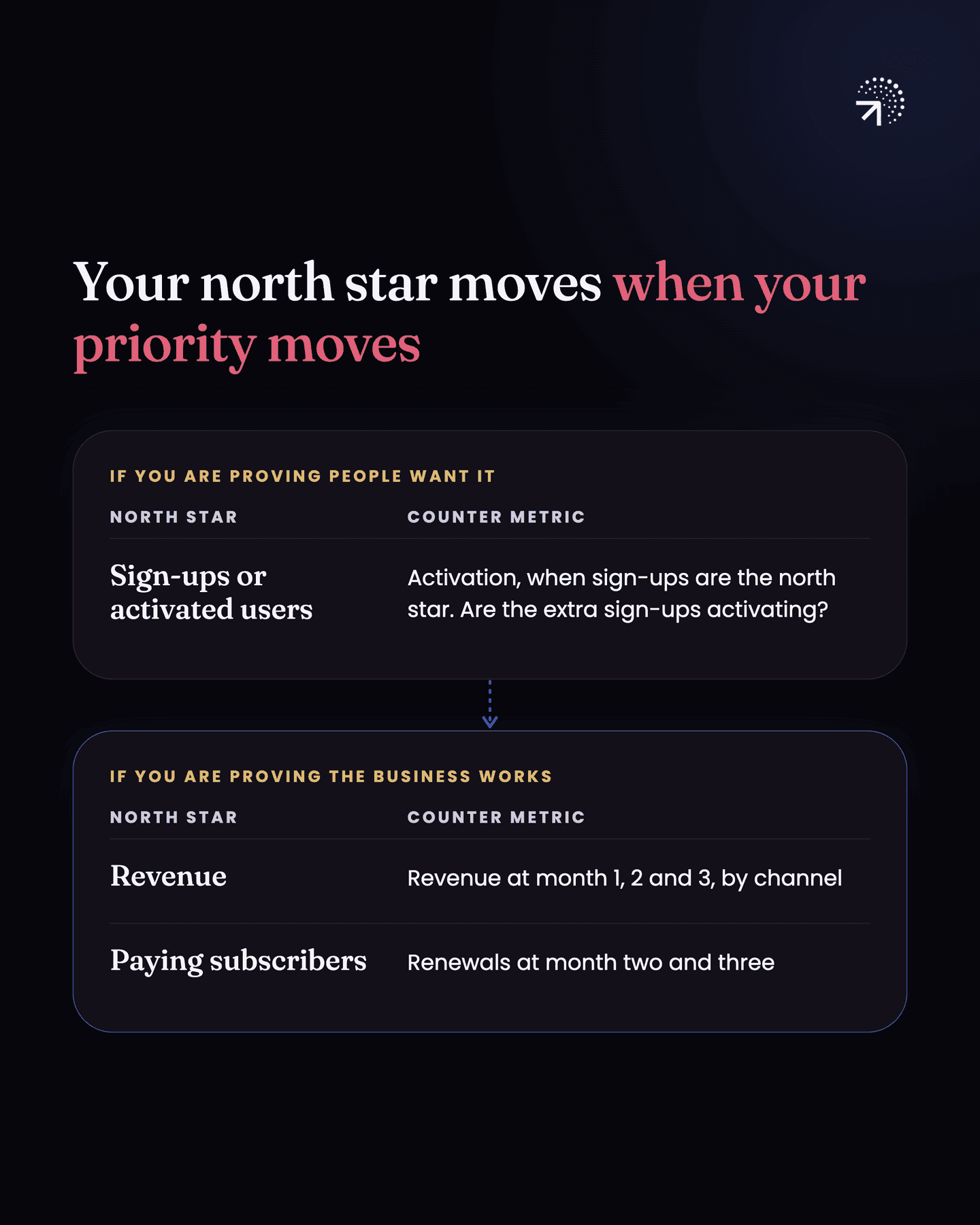
As a founder or a product owner, you should have one north star metric for the company. If you have a large product, individual features can also have their own north star, measured on their own, as long as they feed into the company one. Whether you need that is a product decision and depends on how big the product is.
How do you explain why your north star moved?
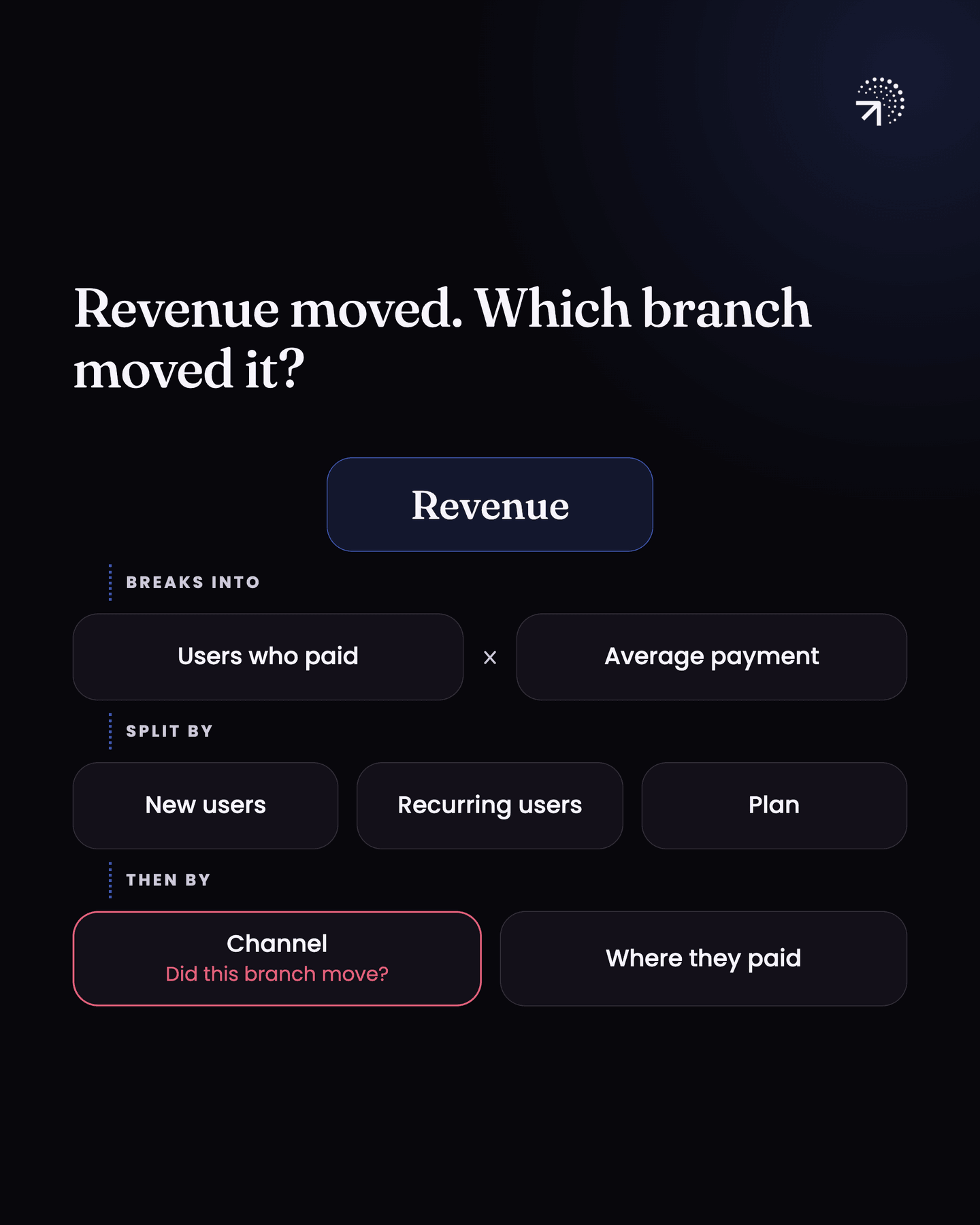
A metric tree explains the movement. Every metric can be broken down into a mathematical formula. Revenue is nothing but the number of users who paid, multiplied by how much they paid. That breaks down further into whether the revenue came from new users or existing ones. And then further still:
- Revenue
- Users who paid
- Amount they paid
The branches are what let you say which one moved.
- what plan they purchased
- what source they came from
- and so on
You can keep going deeper into the tree until you can build a chart that tells you exactly where things changed and what moved. Mixpanel's Metric Trees documentation describes the same structure: input metrics connected up to the top-level outcome, so you can see which input is moving it.
Say you put more money into a specific channel and you want to know whether that moved revenue. What usually happens is that people pour money in, revenue moves, and they decide the channel works. The reality is often that the number moved because of something else that was going on at the same time (more on this in "Correlation is not causation").
A metric tree is what tells you the difference. Go down to the branch for that channel. If revenue from that channel went up, the channel is at least part of the story. If that branch stayed flat and the growth came from another channel, or from existing users upgrading their plan, the money you put in was not what moved revenue.
Here is what a tree for revenue looks like. Start at revenue, then break it down:
- number of users who paid, and how much each of them paid on average
- then new users versus recurring users, and what plan they purchased
- then what channel they came from, and maybe where in the product they paid, for example the pricing page or an in-app upgrade prompt
How do you know a north star gain is real?
A counter metric tells you. If your revenue moves in the short term, that does not always mean you have a win.
Take an example. You bring in a new channel, or you run a new campaign that takes some of the budget from the older one, and revenue goes up a bit. You look at it and think this is converting.
What you see over time is that the revenue from the new channel retains at a much worse level. After month one those users do not pay, revenue starts declining, and you have no idea why.
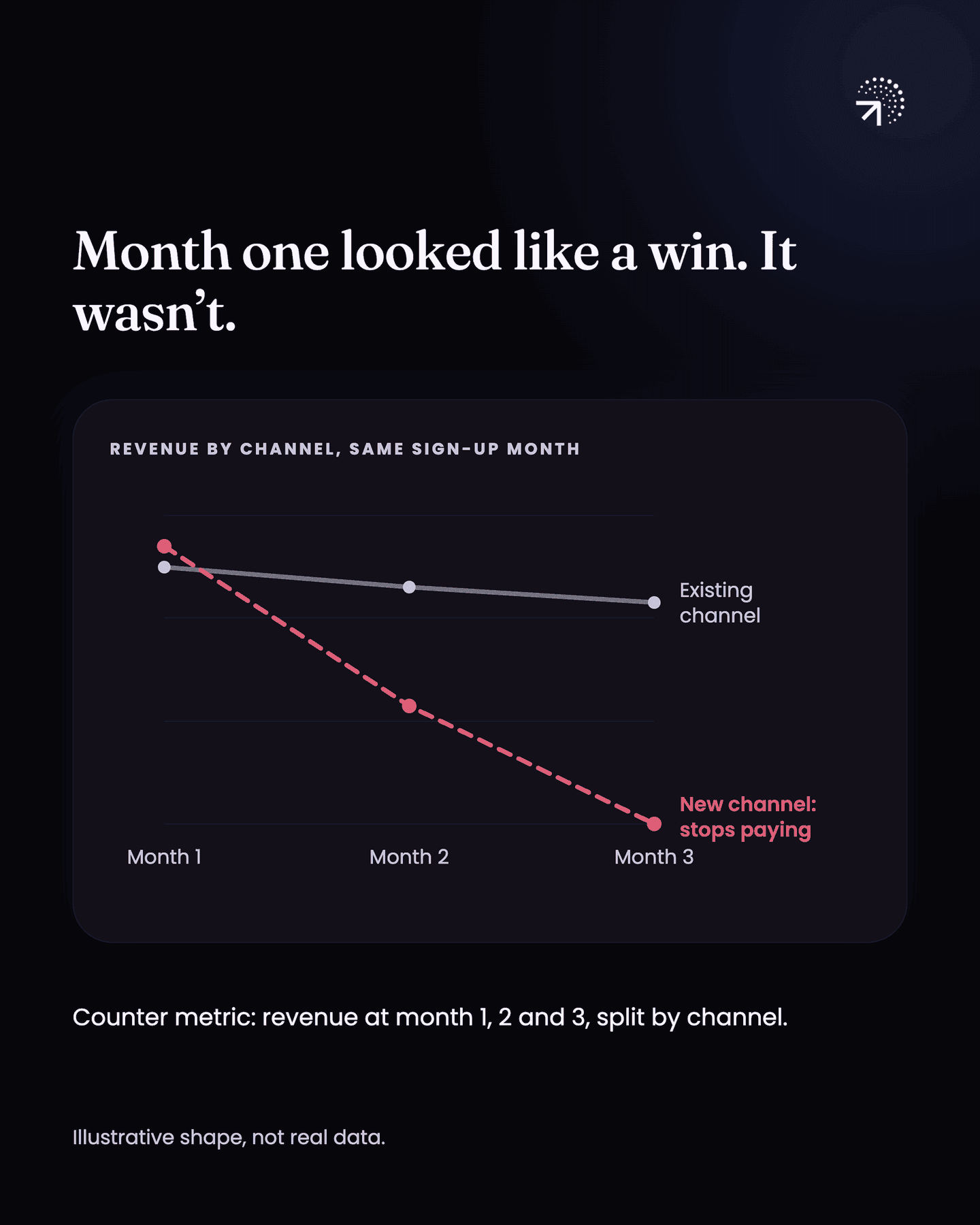
A counter metric is the number you watch next to your north star to check the gain is real.
If revenue is your north star, the most straightforward counter metric is revenue after one, two or three months. Do those people renew? In the example above, looking at month-two and month-three revenue split by channel would have shown you straight away that the new channel's users stop paying. That is the why you were missing.
If sign-ups are your north star, your counter metric could be activation. Yes, you are getting more sign-ups, but is activation going up too? If it is not, you are paying to get more people to sign up while nothing in the product changes. Nothing meaningful is happening.
The cost of a counter metric is time. Month-two revenue by channel does not exist until month two, so you will usually be making the call on a new channel before the counter metric can confirm it. That is fine, as long as you go back and look.
What should you set up for a north star metric?
Most people skip at least one of these. Before you move on, have all three:
- One north star that matches what the business is trying to do right now.
- A metric tree for it, broken down far enough that you can point to the branch that moved.
- A counter metric next to it, like revenue after one, two or three months, or activation, so a short-term bump does not read as a win.
Common questions
What is a north star metric?
One measurable number that matches what the business is trying to do right now, and that you can explain the movement of. Early on that's usually sign-ups or activated users; once you have paying customers it's more likely revenue or subscribers.
What is a counter metric?
A metric you watch alongside the north star to catch gains taken from somewhere else. If sign-ups rise while activation falls, the counter metric tells you the bump isn't real progress.
How many north star metrics should a company have?
One for the company. A large product can give individual features their own north star, as long as each one feeds into the company's.
When should you change your north star metric?
When the business priority changes, for example when you stop proving that people want the product and start proving that the business makes money. Keeping the metric that mattered two stages ago means optimising something the company no longer cares about.