Every product is a funnel: how to model yours
Every product is a set of steps people go through in order, and so is every feature inside it. Count how many people reach each step, find the step where the biggest share drops off, and your problem shrinks from the whole product to one step.
Take the last app you signed up for. You landed on the marketing site or you downloaded the app, you created an account, you went through onboarding, and you got into the product.
Four steps, in order. Walk back through any product you have used and you will find the same shape.
Every feature inside the product is a FunnelThe steps a user goes through in order. Every product is one, and so is every feature inside it. Counting who reaches each step is what shrinks a whole-product problem to a single step.Glossary too. On a social media platform, creating a post is a three-step funnel. You tap create post, you attach your photos, you hit post.
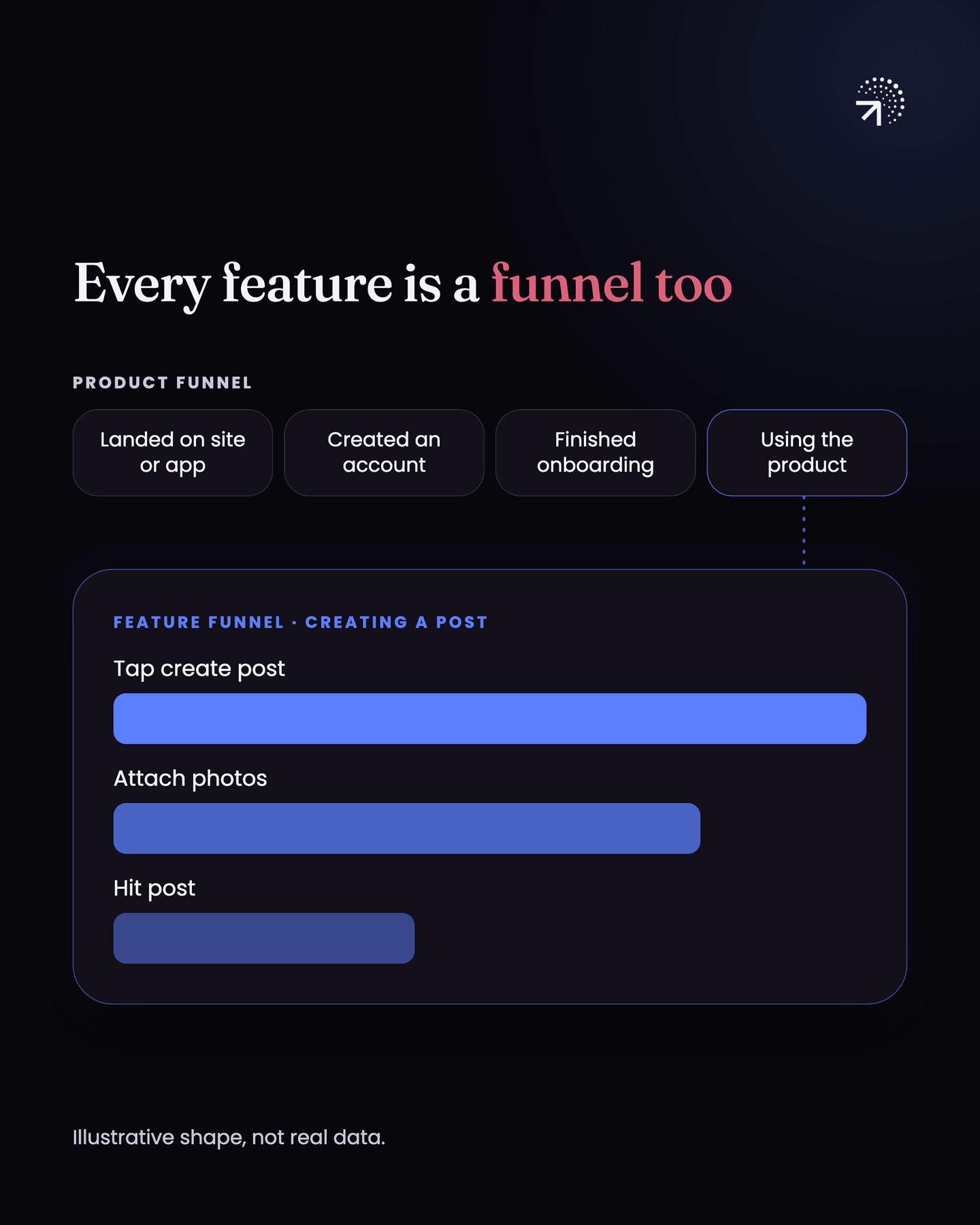
Build this model first, because every other chapter in this book sits on top of it.
How do you model your product as a funnel?
A funnel is just steps in order. Looking at your data as a funnel means three things.
- Write down the steps a person goes through, in order.
- Count how many people reach each step.
- Find the step where the biggest share of people drop off, meaning they reach it and never make it to the next one.
Mixpanel's Funnels documentation describes its funnel report the same way: conversions from one event to the next, within a time window.
| Funnel | Steps, in order |
|---|---|
| The product | Land on the marketing site or download the app, create an account, go through onboarding, get into the product |
| Creating a post (a feature) | Tap create post, attach photos, hit post |
Go back to the create-post example. Say lots of people tap create post, most attach their photos, but far fewer hit post. The drop sits between attaching photos and posting, so that is the only part of the flow you have to debug. You are not looking at the whole product anymore, you are looking at one step.
How does a funnel tell you where to look and what to measure?
Without this model you will keep circling the same three questions: where do I look, what do I measure, and how do I think about this.
The funnel answers all three. You look at the step with the biggest drop. You measure how many people reach each step and how many move on to the next one. And you think about it as people moving through steps in order, then ask why some of them stop.
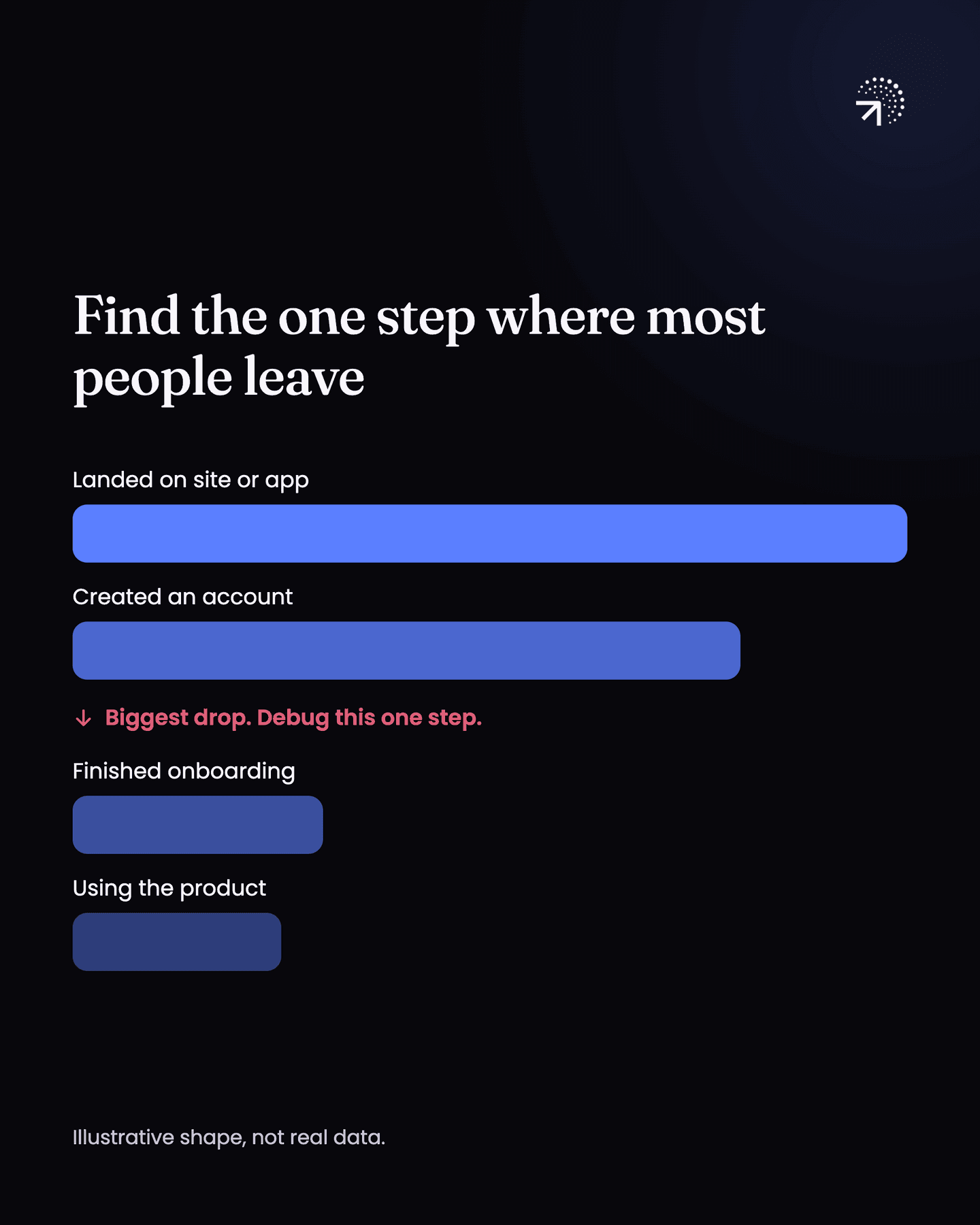
Start here every time you sit down with data. The analysis gets easier and so does deciding what to measure.
Common questions
What is a product funnel?
A funnel is the set of steps a user goes through in order: landing on the site, creating an account, finishing onboarding, reaching the product. Counting how many people reach each step tells you where the biggest drop-off is.
How do you find where users drop off?
Write the steps in order, count the users who reach each one, and compare the share that moves from one step to the next. The step with the largest fall is where your problem lives.
Is a feature a funnel too?
Yes. Every feature inside the product is a funnel. On a social media platform, creating a post is a three-step funnel: you tap create post, you attach your photos, you hit post.
Why model your product as a funnel first?
Because it answers where to look, what to measure and how to think about it. You look at the step with the biggest drop, you measure how many people reach each step, and you ask why some of them stop.