What is product analytics?
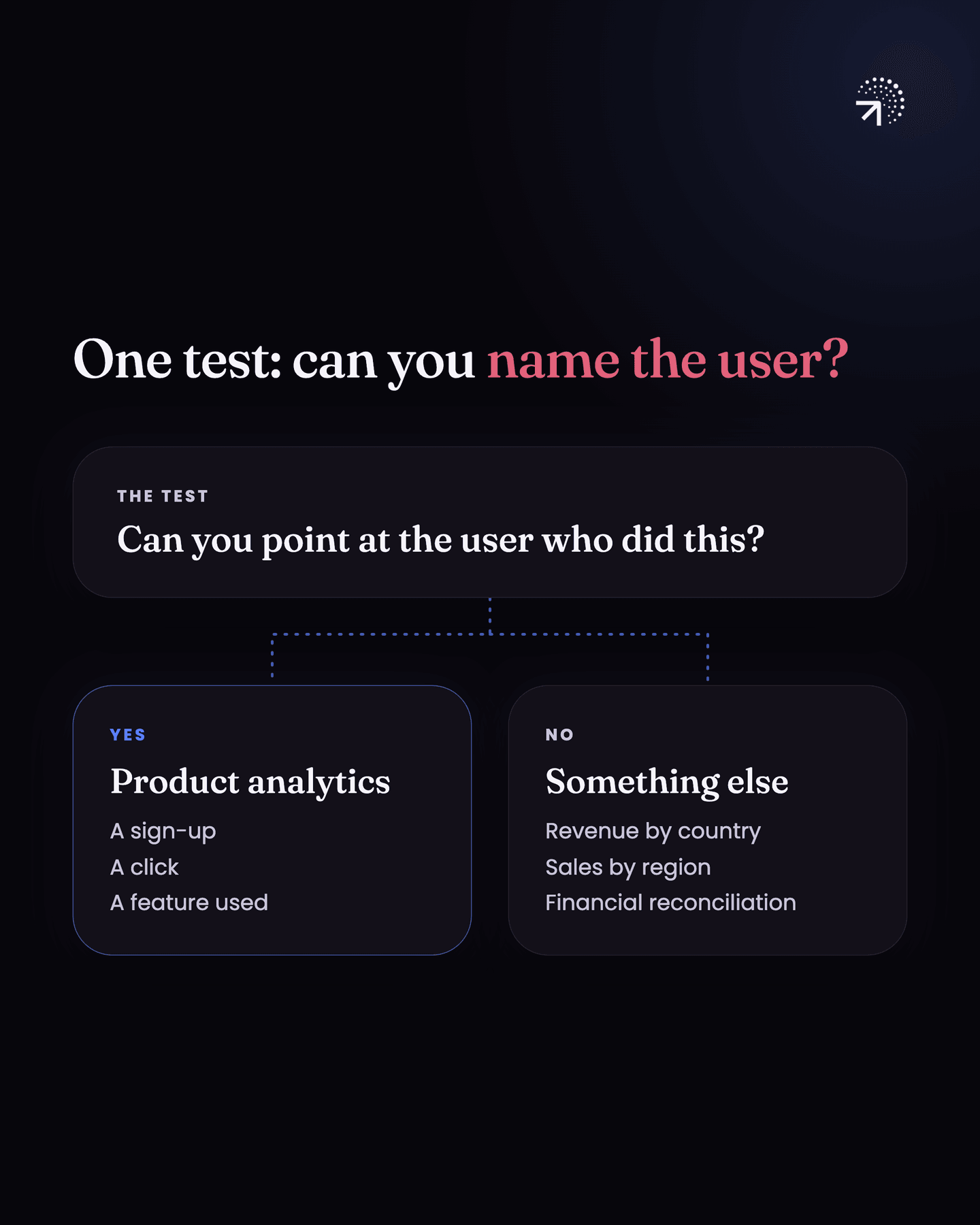
Product analytics is the analysis of what users do inside your product. The test is whether you can point at a row of data and name the user who did it. Revenue by country, sales by region and anything else that can't name a user is not product analytics.
Most Founders and PMs treat product, Data analyticsThe broad term: taking data, pulling insight out of it and understanding what is happening. Product analytics and business analytics both sit under it.Glossary and Business analyticsAnalytics answering questions about business objectives rather than user behaviour: revenue by country, cohorts against targets, reconciling revenue with finance data. It sits alongside product analytics under data analytics.Glossary as the same thing. They're very different, and so are the skillsets, so if you treat them as one you'll struggle the moment you go to hire an analytics person: a strong Data analystThe umbrella title for someone who analyses data. It says nothing about which kind: a strong data analyst can reconcile revenue perfectly and still be a weak product analyst, so hire for the kind of analytics you need.Glossary may be a really bad Product analystAn analyst who works on product analytics: how users move through the product, what you can measure along the way, and how to read those numbers. The question they answer best is "where are users dropping off?"Glossary.
Analytics on its own is simple. You take data, pull some insight out of it, and understand what's happening. That's it.
What makes it Product analyticsThe analysis of what users do inside your product. The test is whether you can point at a row of data and name the user who did it.Glossary is that it's rooted in user behavior. That's the definition I work with, and the test is whether you can point at a row of data and say which user did it. A sign-up, a click, a page view, a feature used by a specific person.
Product analytics tools are built around the same test. Mixpanel's data model documentation describes events as actions that take place within your product, and uses a distinct_id to identify the user associated with each event.
For example:
- You have a website and you're looking at how users move through the FunnelThe steps a user goes through in order. Every product is one, and so is every feature inside it. Counting who reaches each step is what shrinks a whole-product problem to a single step.Glossary: where they drop off, what they use and what they ignore.
- You have a mobile app and you want to see what each user does after they install it: which screens they open, which features they come back to.
All of that is product analytics.
What isn't product analytics?
Questions about business totals, rather than about what users did, aren't product analytics. For example:
- Reconciling financial data.
- Figuring out which country brought in the most revenue.
- Looking at sales data to see which regions sell well and which don't.
These are questions about business totals, not about how users behave in your product. You can answer every one of them without knowing which user did what.
| Question | Can you name the user? | Product analytics? |
|---|---|---|
| Where do users drop off in the website funnel? | Yes | Yes |
| Which screens does each user open after installing the app? | Yes | Yes |
| Which features do users come back to? | Yes | Yes |
| Which country brought in the most revenue? | No | No |
| Which regions sell well? | No | No |
| Do the financial numbers reconcile? | No | No |
So when you look at a report, ask one question: does this tie back to what a user did? If yes, it's product analytics. If no, it's something else.
The next chapter, "Product vs data vs business analytics", covers where product analytics ends and data and business analytics begin.
Common questions
What is product analytics?
Product analytics is analysing what users do inside your product: sign-ups, clicks, page views, features used. The defining test is that every row of data ties back to a specific user. If you can't say which user did it, you're looking at business analytics instead.
What is the difference between product analytics and web analytics?
Web analytics counts sessions and page views in aggregate. Product analytics is rooted in user behaviour, so every event belongs to an identified person and you can follow one user across sessions, devices and features.
What are examples of product analytics?
Looking at how users move through your website funnel: where they drop off, what they use and what they ignore. Or looking at what each user does in your mobile app after installing it: which screens they open and which features they come back to.
Is revenue by country product analytics?
No. Revenue by country, sales by region and reconciling financial data are questions about business totals, and you can answer them without knowing which user did what. That makes them business analytics.